Free iPhone app · iOS 17 or later
World Cup 2026 match probabilities for iPhone
Soccer Odds 2026 reads the odds several bookmakers publish, strips out the bookmaker margin, and turns what is left into fair win, draw and win probabilities, the likeliest scoreline and goal markets for every match of the tournament.

Free download. No account, no sign-up.
Independent app. Soccer Odds 2026 is not affiliated with, endorsed by or connected to any football organisation or governing body. Everything here is statistics and simulation, published for entertainment and information only. The app takes no bets, offers no real money gaming and links to no bookmaker.
What you see on screen
Three screens, one idea
Every number in the app comes from the same place: the odds the betting market is publishing right now, cleaned of the bookmaker margin and pushed through one goal model.
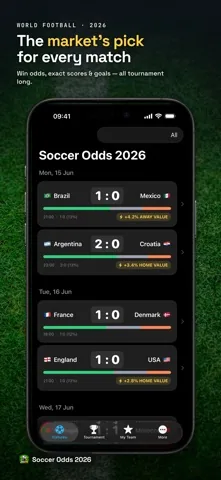
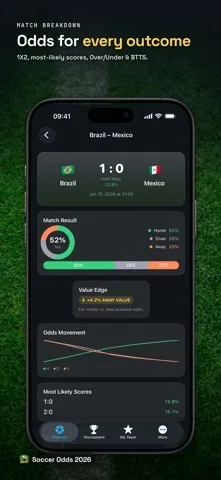
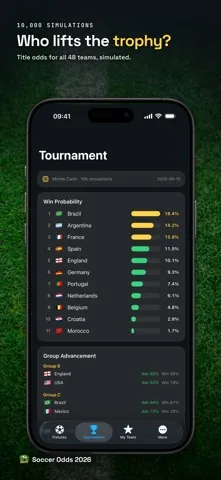
What the app does
- Fair probabilities, margin removedEach bookmaker price already contains that bookmaker's cut, so the three outcomes add up to more than 100 percent. The app divides that overround back out and averages several books, so what you read is the consensus rather than one shop's price.
- The likeliest scoreline for every matchA Poisson goal model with the Dixon-Coles correction for low scoring draws builds a full grid of scorelines from 0:0 to 8:8. The app shows the leading candidate on the fixture list and the whole shortlist on the match screen.
- Goal markets, not just the winnerThe chance of three or more goals, the chance that both teams score, plus over 1.5 and over 3.5 goals and expected goals per side. These come off the same scoreline grid, so they never contradict the win, draw and win split.
- The whole tournament, simulated ten thousand timesTeam strength is estimated from the expected goals of the group matches, then the draw is played out ten thousand times with a seeded random generator. The result is a title probability and a round by round survival chance for all 48 teams.
- One team, followed properlyPick a favourite and the My Team screen shows its title chance and its path through the draw, so you do not have to hunt for it in the fixture list.
Free on the App Store.
Who it is for
Three kinds of people get something concrete out of a probability instead of an opinion.
You are in a prediction pool
Office pools, family pools, Kicktipp rounds: they all ask for a scoreline, and most people guess with their heart. A probability tells you how big the gap between two teams really is, and the scoreline grid tells you that even in a heavy mismatch the single likeliest result is usually a modest 2:0 rather than the rout it feels like. There is a full walk-through in the prediction pool guide.
You follow one team
Pick your side once and the My Team screen keeps its title chance and its path in one place, so you do not scroll a 104 match list to find the two fixtures you care about.
You like the numbers themselves
The whole chain is documented and reproducible: odds in, margin out, goal model, grid, markets. If you want to build it yourself, start with turning odds into probability and then the Poisson and Dixon-Coles model.
Method
How the numbers are made
- Collect the prices. A scheduled job asks an odds aggregator for the head to head and the over/under 2.5 market for every fixture, in decimal format, from the European books.
- Remove the margin. Each price becomes an implied probability, which is one divided by the odds. Those three add up to more than one, and the excess is the bookmaker's cut. Dividing each by the sum takes the cut back out, which is the proportional method.
- Average the books. The margin free numbers are averaged across every bookmaker that quotes the match, so no single shop's opinion decides the result.
- Fit a goal model. The over/under market fixes how many goals the match is expected to hold. The win probability fixes how those goals split between the two sides. That gives one scoring rate per team.
- Build the grid. Those rates produce a table of every scoreline from 0:0 to 8:8, corrected with the Dixon-Coles factor that lifts 0:0 and 1:1 and trims 1:0 and 0:1. Every market shown in the app is read off that one grid, so the numbers can never contradict each other.
Nothing is computed on the phone. The job runs every six hours and publishes one JSON file, which the app downloads and caches. That is also why the app is free to run at any download volume.
The 2026 archive, on this site
The tournament ran from 11 June to 19 July 2026, and every one of its 104 matches was priced by the market before kick-off. Those numbers are collected here, group by group and round by round. They are the record of what the market expected, published before the matches were played.
The five most one-sided matches of the tournament
| Match | Home | Draw | Away | Likeliest score |
|---|---|---|---|---|
| Germany v Curaçao14 Jun, 17:00 UTC | 92.6% | 5.8% | 1.6% | 3:0 13.1% |
| USA v Australia19 Jun, 19:00 UTC | 92% | 7.6% | 0.4% | 2:0 22.5% |
| Mexico v Ecuador1 Jul, 02:00 UTC | 91.5% | 8.3% | 0.2% | 2:0 24.9% |
| Spain v Cape Verde15 Jun, 16:00 UTC | 89.7% | 8.1% | 2.3% | 3:0 14.2% |
| France v Senegal16 Jun, 19:02 UTC | 89.6% | 10.2% | 0.2% | 2:0 25.8% |
The five closest matches of the tournament
| Match | Home | Draw | Away | Likeliest score |
|---|---|---|---|---|
| Paraguay v Australia26 Jun, 02:00 UTC | 33% | 33.2% | 33.8% | 0:0 14.8% |
| England v Argentina15 Jul, 19:00 UTC | 35.3% | 30.5% | 34.2% | 1:1 14.3% |
| France v Spain14 Jul, 19:00 UTC | 36.8% | 29.1% | 34% | 1:1 13.9% |
| Egypt v Iran27 Jun, 03:00 UTC | 36.9% | 32.7% | 30.4% | 1:1 14.6% |
| Ivory Coast v Ecuador14 Jun, 23:00 UTC | 29.6% | 32.8% | 37.6% | 1:1 14.5% |
Reading the bar: home windrawaway winPercentages are the fair market consensus after the bookmaker margin is removed.
See the same numbers on your phone.
Frequently asked questions
What is Soccer Odds 2026?
Soccer Odds 2026 is a free iPhone app that shows the betting market consensus for the matches of the 2026 World Cup. It reads the odds several bookmakers publish, removes the bookmaker margin, and turns what is left into fair win, draw and win probabilities, the likeliest scoreline and two goal markets. It takes no bets and it recommends none.
Where do the probabilities come from?
From a scheduled job, not from the phone. Every six hours a job collects the head to head and the over/under 2.5 odds that several bookmakers publish for each fixture, converts each price into an implied probability, divides out the overround so the three outcomes add up to 100 percent again, and averages the result across the books. That average is the market consensus. A Poisson goal model with a Dixon-Coles low-score correction then turns the consensus into a full scoreline distribution.
Is Soccer Odds 2026 a betting or gambling app?
No. The app accepts no bets, offers no real money gaming and links to no bookmaker. It displays probabilities derived from public odds, for entertainment and information. It is independent and is not affiliated with, endorsed by or connected to any football organisation or governing body.
Is Soccer Odds 2026 free?
The download is free and there is no subscription. The free app is supported by ads through Google AdMob. There is one optional in-app purchase, called Pro Unlock, which is a single one-time payment that removes the ads and opens the deeper analysis screens. Nothing renews and no account is needed.
What does the app show for each match?
The win, draw and win split after the margin has been removed, the likeliest scoreline, and two goal markets: the chance of three or more total goals and the chance that both teams score. The match screen adds expected goals for each side, more scoreline candidates and how the probabilities moved in the days before kick-off. A separate screen simulates the whole tournament ten thousand times.
The 2026 tournament has been played. Does the app still list fixtures?
The app reads a live feed that lists the matches bookmakers are currently pricing. The 2026 tournament ran from 11 June to 19 July 2026, so between tournaments that list is empty and the app says so on screen. The complete record of how the market rated all 104 matches, group by group and round by round, stays available on this site.
How accurate are the probabilities?
No hit rate is claimed, because none has been measured and published. The numbers reflect the aggregated betting market, which is a well informed public signal, but a probability describes likelihood and not certainty. A match given a 90 percent chance still loses roughly one time in ten, and that is the model working as intended rather than failing.